

As I pull through the water, the pool’s black line beneath me, I feel the tears come.
They’re a little unexpected, but not at all unwelcome. I’m not worried by them. I’ve learned that tears are my release. They are my body coming to terms with something.
As they come, I acknowledge that this is my reaction to the 2-day-old realisation that an Olympic story I’ve been telling myself for 22 years - and one that I’ve told publicly hundreds of times to tens of thousands of people in workshops, speeches, articles, and podcasts - isn't entirely true.
The ending hasn’t changed, but the events throughout the story have. And that significantly changes the meaning.
The tears mean that, after more than two decades, I’m realising that it wasn’t all my fault that we didn’t win an Olympic medal.
As absurd as that may sound, bear with me.
Let me share the original story first, then tell you how what happened a week ago changed so much.
The story
Here’s the story that I’ve told privately to myself and publicly for 22 years.
--
Picture this:
It’s 2004, the Athens Olympics.
It’s been 11 years since I first wrote down that I wanted to play for Australia. It’s been a roller coaster to this point.
An insanely intense year at the Australian Institute of Sport straight out of high school. Missed selection on the Sydney Olympic team. Made the 2001 World Championship team. Made the 2003 World Championship team.
I’ve survived injuries and the curveballs of life, and now, here I am, playing on the Australian Water Polo team in Athens.
It’s my dream come true.
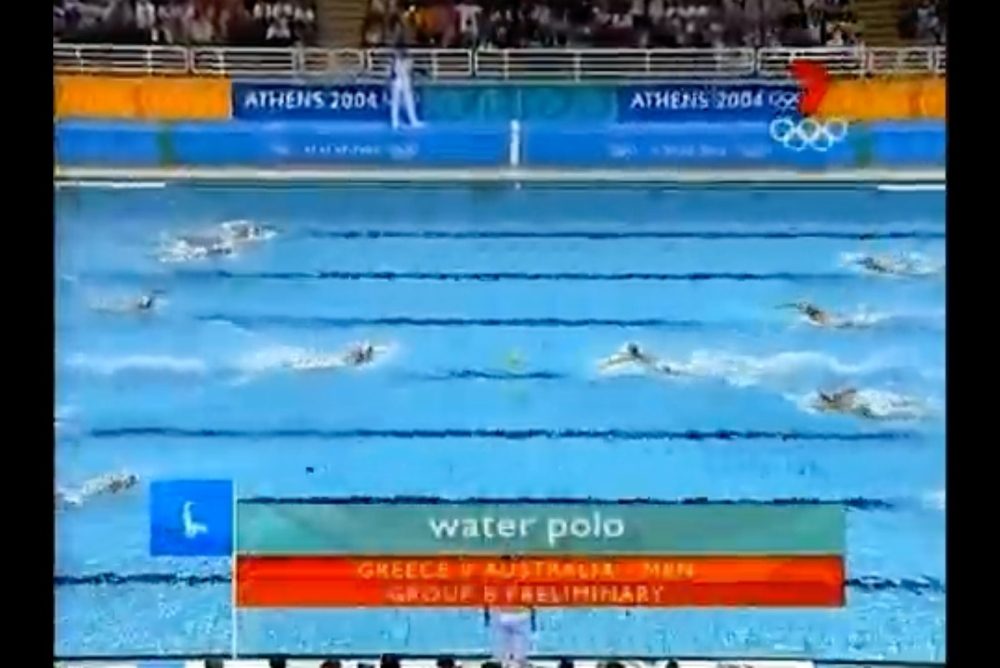
It’s game 3, and we’re playing Greece.
It's a medal critical game. The winner stays in medal contention; the loser is knocked out.
The indoor stadium is packed.
I’m in the middle of the pool, and up on my right are 6,000 Greeks going berserk for their home team. It's a raging sea of Hellenic blue and white. The sound is deafening.
In the crowd are islands of green and gold. Australian supporters are decked head-to-toe in wigs, face paint, and t-shirts. My family are there: mum, dad, my three sisters, and brother. Friends have flown from Australia to watch.
We’re 30 secs from halftime and leading by a goal.
The Greeks miss a shot down our end, and I start sprinting up the pool.
My goalkeeper launches the ball down the field.
It sails over my head and lands on the water in front of me.
There’s me. The ball. And the Greek goalkeeper, ten metres away.
I'm exhausted from already playing half of the most intense game of my life. At the same time I'm absolutely jacked on the adrenaline and excitement of the moment—what it means to me, my team, and my country.
My mind kicks into overdrive.
Get me out of here.
I miss these shots in training.
I miss these shots in games.
I wish someone else was taking this shot.
I try to turn it around.
Come on mate.
This is your turn.
You’ve trained for 11 yrs for this.
It’s the Olympics.
Your family’s in the stand.
You can do it! Let’s go, let’s go, let’s go!
I sprint in.
I pick up the ball.
I baulk once.
I shoot…
The Greek goalkeeper saves it.
I sink to the bottom of the pool, mortified I've missed this shot. I can't believe it. I'm supposed to score these.
As I come back to the surface, I look to my left and see my teammate, Deano. He's four metres away. He's been screaming at me all the way up to the pool, but I hadn't heard him.
To make matters worse, I watch the Greek goalie throw the ball the full length of the pool to one of his players.
They pick up.
They shoot.
They score.
Instead of being two goals up, we’re even.
Momentum lost. Gone.
I still can’t believe I missed the shot.
The game plays on. We lose.
We’re out of the medals.
We finish the Olympics in 9th position.
Did it all boil down to that one shot?
No, of course not. There were many moments in many games.
But some days it still feels like it.
--
That’s how I’ve told this story. For 22 years.
But then something happened.
The shift
6 months ago a client asked if I had any video footage of the shot from the Athens games to share in my workshop. I didn’t.
In the back of my mind I knew my grandmother had recorded the TV footage of the games back then and given me the VCRs. I’d never been able to bring myself to watch them.
Then 2 months ago, another client asked if I had footage. This time I decided to dig.
After a few weeks, I finally tracked down digitised recordings and saved them in my work files.
I had a quick look.
The Greek game was at the top of the folder. I pressed play. I noticed my adrenalin kicking in as I watched and listened to the commentary.
I watched the first minute. Then I stopped. I figured I’d come back to it later. When I had more time.
Weeks went by and the videos stayed in my files unwatched. I knew they were there, but I kept avoiding them.
Then on a cold winter’s morning, a week ago, everything changed.
My in-laws were staying at our place with their daughters. I mentioned to my brother-in-law that I’d sourced copies of the games.
“Let’s watch them with the girls this morning, mate! That’d be awesome!” he said.
I felt self-conscious and knew I was going to have to watch this shot again if I said yes.
But maybe it was time to watch this game that I’d avoided for 22 years.
So we did.
It turns out the video of the shot played quite differently to my mind’s story.
The differences
The game kicked off. The moment of the shot arrived.
We were even and 20 seconds from halftime.
Instead of the Greeks missing a shot, there was a turnover.
Yes, I sprinted.
It wasn’t my goalie who had passed me the ball. It was my teammate Deano passing from halfway. He was nowhere near me.
When the ball landed, I was 5 m from the Greek goal with a tough angle for a right-hander.
There was no one I could have possibly passed the ball to.
There was a Greek player about to leap on my shoulder.
I didn’t have time to baulk.
It was always going to be a low-percentage shot but one worth taking.
It was the right decision to take the shot at that stage of the game.
The Greek goalie did save it.
He did pass it up the field where their player was waiting.
Our goalie was excluded.
They scored as the game clock for the second quarter hit 00.00.
(I wish I could show you the video but copyright is tough these days.)
The realisation
While it didn’t change the fact that I hadn’t scored and the Greeks had, being able to watch the game situation made me realise that it was different enough from the story to the one I’d been telling myself for 22 years.
That changed my perspective.
I hadn’t missed an easy pass to my teammate after all.
I hadn’t made a terrible decision.
Which meant that it wasn’t solely my fault that we lost the game to Greece.
And therefore, it wasn’t solely my fault that we missed out on the quarterfinals.
And therefore, it wasn’t solely my fault that we didn’t win a medal in Athens.
The absurd
This kind of reasoning may seem absurd to an outsider looking in.
Honestly? It staggers me too.
That a single moment, that 22 years later turned out not even to be true, would cause me to think that it was entirely my fault that we didn’t win a medal in Athens.
That, in some real way, I’d been blaming myself for 22 years.
Intellectually I knew it wasn’t solely my fault, but my body appears to have been hanging onto that old story this whole time.
To make matters even more surreal, as I watched the game again, in the first quarter I actually scored a goal.
A good one.
I couldn’t believe it.
I had to rewind the video to double-check it was actually me.
It was. And I still have zero recollection of scoring that goal.
Coming to terms
As I watched my 23-year-old self playing the game and taking those shots, I felt an appreciation for the effort I’d put in.
I saw my family in the stands sharing the moments with me and felt incredibly grateful they were there. To witness the lot.
I felt pride as I saw all the moments of the game as my teammates gave their all too. With both mistakes and outstanding moments.
I recognised that we always had, and would always have, a shared responsibility for the outcome.
And I saw the Greeks playing their hearts out too in front of their home crowd.
It was an incredible game of water polo.
The elation and the disappointment. The highs and the lows.
As I watched, I acknowledged that, even with the huge aspiration on both sides, one team must win and one must lose. This is the brutal reality of sport.
As the days have unfolded since watching it back, the tears have come and gone again on occasion. And in doing so I’ve felt like I’ve brought that 23-year-old, hugely disappointed me, back home from Athens.
To accept some responsibility, sure.
But to temper that edge of self-blame.
The lessons
I write to help me process.
To try to integrate this new perspective and understand what it means.
When I used to tell the original story - with full conviction that it was the truth - the lessons were all about how we deal with stress and pressure.
The thoughts, the feelings, the sensations.
It was my launchpad into how the toolkit from psychological flexibility can help us learn to work with them. Help us learn to take the best possible action when it truly matters. Help us learn how we can perform when the stakes feel the highest.
The updated story hasn’t changed any of those lessons. They still apply.
And actually I realise now that the same toolkit used in present-day moments is just as useful when applied to the painful, difficult memories that we cannot delete.
And a final lesson feels deeper and more human.
That our minds are storytellers, not historians.
That our mind’s stories are not always kind.
And that our mind’s stories are not always useful.
I’ve been fortunate on this occasion. There aren’t many moments of a life where we can compare our mind’s stories with actual footage to draw lessons.
Either bad or good, I should note.
But perhaps there’s something in your life, one of your stories you’ve been telling yourself for a long time that hasn’t been helpful. A moment of regret. A moment where you wished something had turned out differently.
I hope in acknowledging that pain, we can still realise that we have a path to move forward.
That perhaps, regardless of whether they are good or bad, we need to keep honing our skills for recognising our mind’s stories and accepting them for what they are.
Not the truth. Not wholly right. Not wholly wrong.
They’re stories.
Just stories.